
Wellness Interior Design Trends 2027: How a $2.7 Trillion Market Is Changing Home Design
The home you build or design is no longer just a place to live—it is a product that wellness-oriented buyers are evaluating for recovery, sleep quality, air quality, and long-term health. The global wellness market has reached $2.7 trillion, with the United States accounting for roughly $700 billion. What began as a niche interest has become a core driver of consumer behavior and identity. More than a third of US consumers now view wellness as central to who they are, and two-thirds say they prioritize it more than they did a year ago. Across generations, it ranks as the second-highest life priority—behind only family.
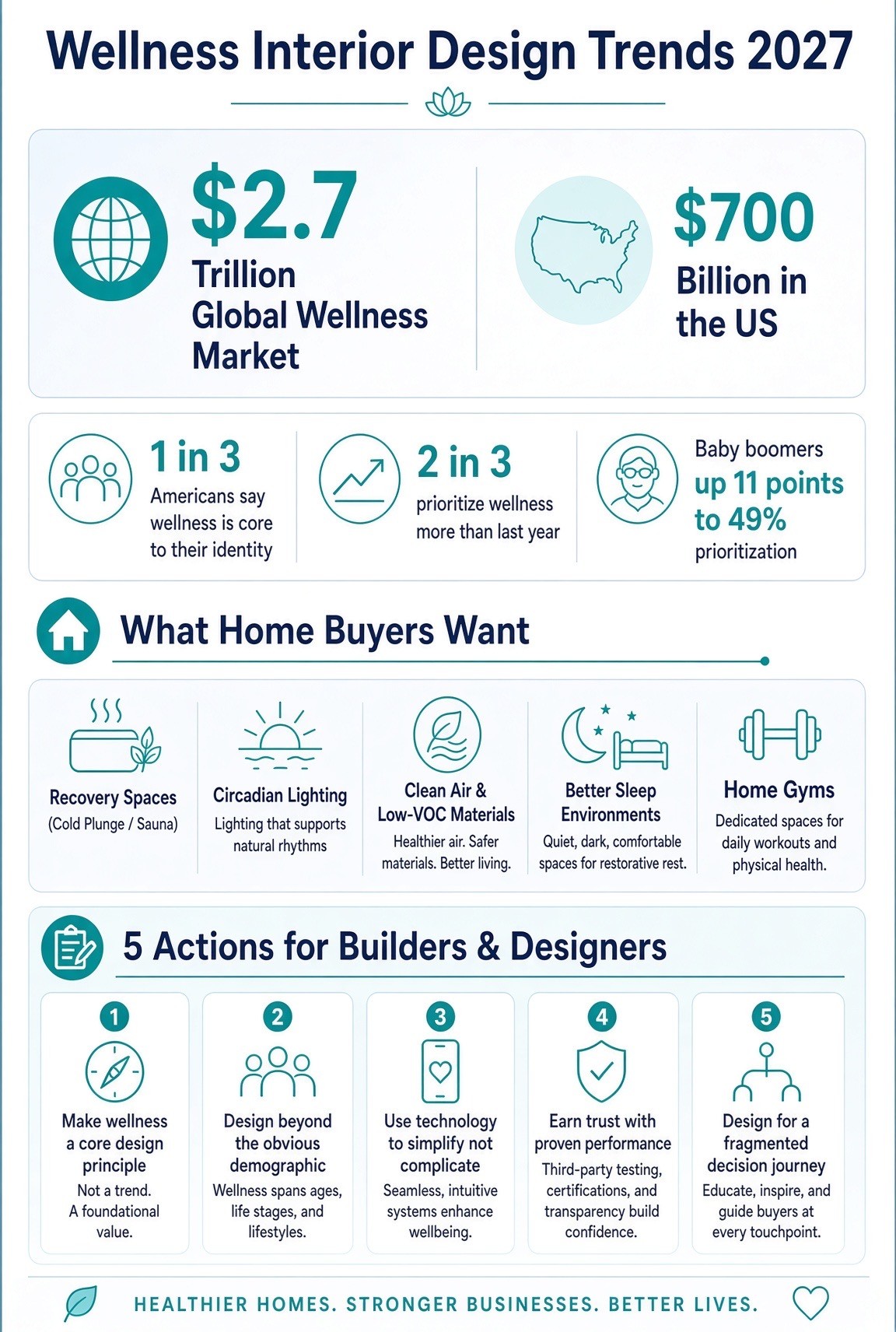
Wellness Moves from Niche to Identity
While Gen Z and millennials remain the largest spenders, older groups are catching up quickly. Baby boomers showed the sharpest rise in prioritization, climbing 11 percentage points to 49%. At the same time, consumers are shifting from basic health maintenance to active optimization. This is fueling interest in recovery practices (cold plunges, contrast therapy, social saunas), biohacking habits, higher protein and creatine intake, and personal diagnostics. AI is widely used for guidance, yet trust remains limited; friends, family, and healthcare practitioners still influence decisions far more than chatbots. Effectiveness now ties price as the top purchase driver.
What This Means for the Built Environment
These shifts are reshaping expectations for the home. Builders, architects, and interior designers are seeing rising demand for restorative rather than clinical spaces. Concrete opportunities include dedicated recovery zones or cold-plunge-ready areas, circadian lighting systems that support natural sleep cycles, enhanced air filtration paired with low-VOC materials, and quiet rooms or sound-masking solutions that reduce stress. Features that make personal health data easier to access and spaces designed for better mobility are also gaining interest.
Five Actions for Builders, Architects, and Interior Designers
According to McKinsey’s Future of Wellness 2027: Inside the $2.7 Trillion Takeover (November 2026), based on a survey of more than 10,000 consumers across the US and world, five practical actions stand out for professionals in the built environment:
1. Make wellness a core design principle. Treat it as a structural element of the project rather than a marketing add-on. Identify specific needs—such as recovery, daily fitness, sleep quality, air quality, or mobility—and integrate them into the architecture, systems, and finishes from the outset. For example, plan mechanical systems and floor layouts early to support future cold plunge or fitness rooms rather than treating them as later upgrades.
2. Design beyond the obvious demographic. Younger buyers matter, but older adults and those who want better health yet feel held back by stress or motivation are prioritizing wellness more strongly. Accessible recovery spaces, clear lighting, and low-maintenance features can serve a wider range of clients—such as single-level recovery suites or lighting controls that are simple to operate without an app.
3. Use technology to simplify, not complicate. Integrate smart systems that turn data into clear, useful guidance—for example, lighting and temperature that automatically support better sleep—rather than adding more notifications and complexity. A system that gently shifts color temperature and lowers the thermostat at a set evening time is more valuable than one that simply alerts the homeowner to every metric change.
4. Earn trust with clarity and proven performance. Consumers want evidence that spaces and materials work. Prioritize measurable benefits such as improved air quality, non-toxic materials, and designs informed by sleep or recovery research, and communicate those benefits transparently. Specifying MERV-13+ filtration or third-party-tested low-VOC finishes and explaining the expected impact on air quality helps buyers understand the value.
5. Design for a fragmented decision journey. Clients discover and evaluate wellness homes through AI tools, social platforms, creators, experts, and in-person experience. Make the wellness story visible, specific, and verifiable across these channels so it holds up under scrutiny. Clear project photography of recovery spaces, straightforward language on material health, and easy-to-share specifications all support this.
Building for the Wellness Takeover
The wellness shift is already changing how people want to live. Builders and designers who treat it as a genuine priority—rather than a surface-level trend—will create homes that better match rising expectations and capture lasting demand. Which of these five actions are you already applying on current projects?
Source
McKinsey & Company. (November 2026). Future of Wellness 2027: Inside the $2.7 trillion takeover. Consumer Packaged Goods Practice. Authors: Anna Pione, Eric Falardeau, Jon Medalsy, Kristi Weaver, Sara Hudson, Shaun Callaghan, and Stefan Rickert.